Industrial
inspection
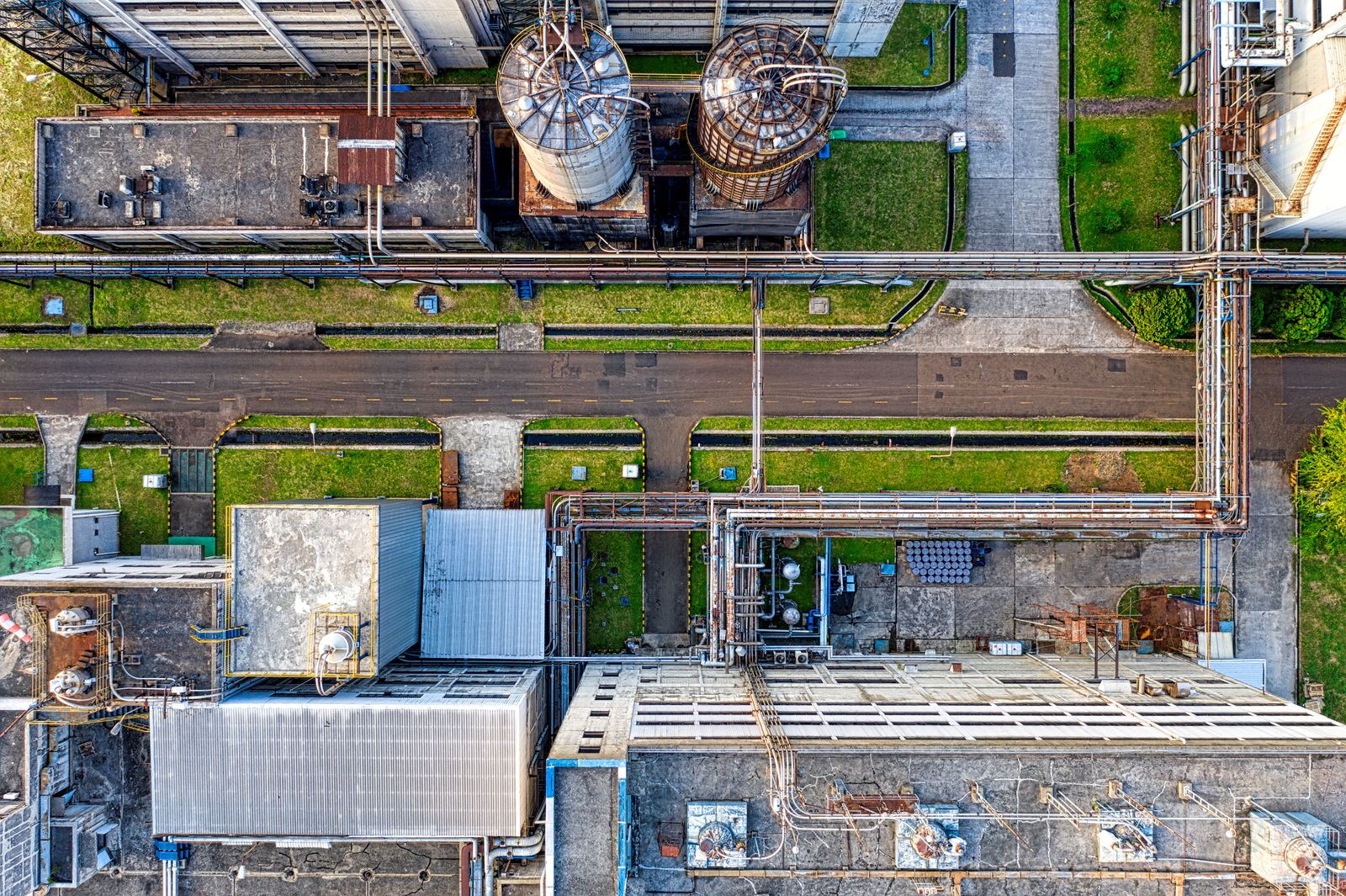
Industrial drone inspection and thermography in Catalonia: warehouses and roofs, chemical and petrochemical plants, towers, chimneys, tanks and silos. We detect corrosion, damage and hot spots without stopping production or setting up scaffolding. AESA-authorised operator and technical report.
Industrial
assets
We reach the critical points of a plant from the air, without entering the process area and without stopping anything.
Industrial warehouses and roofs
Inspection of large-surface roofs (sheet metal, fibre cement, sandwich panel), skylights, downpipes and leak points without climbing onto a rooftop that is often hard to access.
Chemical and petrochemical plants
Inspection of pipe racks, process towers and structures at the Tarragona complex and other plants, coordinating each flight with safety and prevention.
Towers and chimneys
Chimneys, cooling towers, antennas and tall structures inspected from top to bottom without ladders or vertical work by an operator.
Tanks and silos
Tank roofs, silos, gasometers and tanks: coating condition, corrosion and deformations seen from above, without confined-space access.
Lines and structures
Power lines, overhead cranes, walkways, frameworks and metal structures that are difficult to access inside and outside the site.
Predictive maintenance
Periodic campaigns to anticipate corrosion and wear, plan shutdowns and prioritise actions with objective data.
Data for
maintenance
The hot spot
before the breakdown
In a plant, a thermal anomaly is often the first symptom of an unplanned shutdown.
Industrial drone thermography captures the infrared radiation of equipment and structures to reveal what is not visible to the naked eye. Flying over the facility, we locate hot spots in outdoor electrical panels, busbars, transformers and lines; overheating in motors, bearings and couplings; thermal leaks in insulated pipes and tanks; and insulation losses in warehouse roofs. All of this with the plant running, which is precisely when electrical and mechanical faults show up.
We combine thermography with high-resolution imaging to document corrosion, coating loss, detachments and deformations in towers, chimneys, tanks and metal structures. The result is a precise, non-invasive diagnosis that allows the maintenance manager to anticipate the repair and plan it for the next shutdown, without scaffolding and without stopping anything. This service is part of our technical drone inspections; when it is necessary to measure stockpile volumes or model the plant in 3D we combine it with drone surveying and photogrammetry.


Industrial
questions
Do you need to stop production to carry out the inspection?
No. The drone works from the air and at a safe distance, so we inspect warehouses, towers, chimneys and tanks with the plant running. There is no need for a production stoppage or a general shutdown to access a roof or an element at height: the flight is completed in a matter of hours, without entering process areas or interrupting any line.
What does thermography bring to an industrial environment?
Industrial thermography captures infrared radiation to detect hot spots in outdoor electrical panels, busbars, transformers and lines, overheating in motors and bearings, thermal leaks in pipes and tanks, and insulation losses in warehouse roofs. It sees what the eye cannot and makes it possible to locate an anomaly before it causes a breakdown or an unplanned shutdown.
Do you detect corrosion and structural damage?
Yes. With high-resolution imaging we document corrosion, coating loss, detachments, cracks, deformations and damage in towers, chimneys, metal structures, tanks and silos. The drone gets close to ridges, joints and welds that are impossible to inspect from the ground without setting up scaffolding or hanging an operator. Our job is to document and locate; the assessment and structural calculation are always carried out by the competent technician.
Do you work at the Tarragona petrochemical complex?
Yes. We fly at chemical and petrochemical plants in Catalonia, including the Tarragona complex, coordinating each flight with the facility's safety and prevention department and respecting work permits, ATEX zones and the plant's protocols. As an AESA-authorised operator, we handle the flight authorisations and, when necessary, the permits with the authorities or the Mossos d'Esquadra in Catalonia.
Do you need access to the roof or the structure?
No. The drone works from the air, so we inspect warehouse roofs, towers, chimneys, tanks and silos without climbing up, without setting up scaffolding and without aerial work platforms. We only need a safe take-off point nearby, to coordinate it with the plant and, if applicable, the permits, which we manage ourselves as an AESA-authorised operator insured with public liability cover of €1,500,000.
What does the technical report include?
A technical report with high-resolution imaging and, when needed, thermography, in which we locate each detected anomaly (corrosion, damage, hot spots, thermal leaks, insulation losses) with the exact point and an assessment of its condition. It is material designed so that the maintenance manager and the plant engineer can plan the actions and prioritise them with data. Ask us for an example.