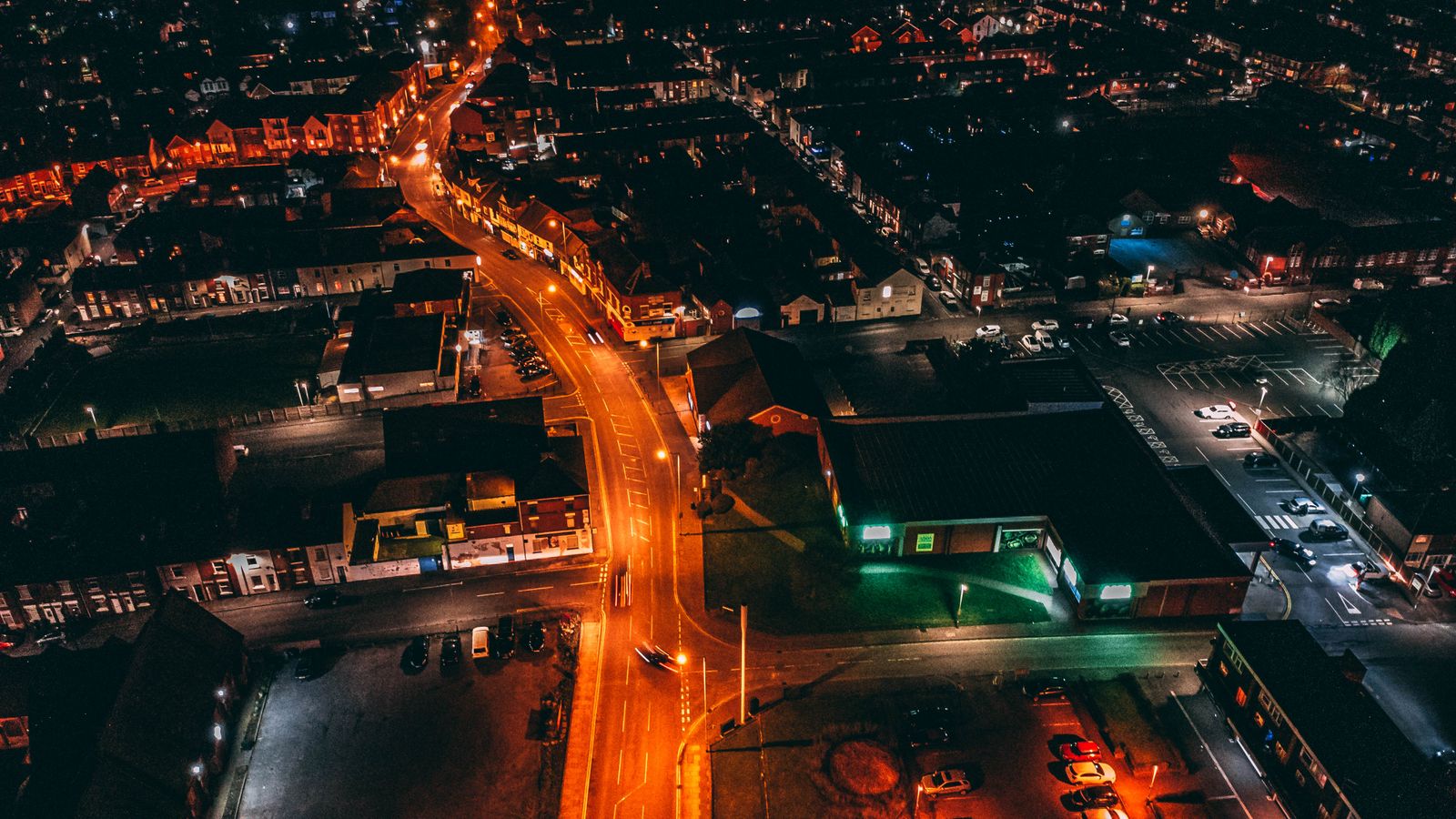
Night has an obvious appeal for anyone who wants aerial images: city lights, the spotlights of a stage, an illuminated façade or an industrial plant that never stops all have a power that is lost during the day. That's why we receive so many enquiries about filming at night. The short answer is yes, you can fly a drone at night, but under conditions that aren't the same as during the day and that are worth being clear about before planning anything.
This article goes over what night flying requires, which projects it really makes sense for and which preliminary steps you can't skip in Catalonia. It isn't a promise that your specific flight can be done: it's the honest information so you understand where the limits are and can make an informed decision.
What you need to fly a drone at night
1. Visible lighting: the flashing green light
The most distinctive requirement of night flying is that the drone must carry a flashing green light that makes it visible and allows its orientation to be identified in the dark. It isn't an optional accessory or an aesthetic detail: it's the way anyone —and the pilot themselves— can know where the aircraft is and which way it's pointing when there's no natural light. Without this signal, night flying simply cannot be carried out within the regulations.
This means the equipment has to be checked beforehand. Not all drones carry this lighting as standard, and not all additional mounts work, so it's part of the technical preparation for the flight, not a last-minute add-on.
2. More planning and, often, a risk assessment
At night you lose visual references that are taken for granted during the day: obstacles, cables, trees, changes in the terrain. That's why night flying calls for more advance planning than an equivalent daytime flight. Surveying the area in daylight, defining safe take-off and landing points and anticipating where each obstacle is stops being a recommendation and becomes part of the job.
Depending on the category of the operation and the area, this planning may include a risk assessment and specific authorisations. A night flight in the open category in a controlled, unpopulated environment is not the same as an operation over people or in an urban area, where the margin is narrower and the documentation more demanding. The category and the location determine what's needed in each case, and this has to be looked at project by project.
Which projects night flying makes sense for
Night flying doesn't pay off for everything. It has a higher preparation cost and a smaller margin for error, so it makes sense when night brings something you can't have during the day. These are the cases where it's usually requested for a good reason:
Night-time events
Concerts, festivals with fire runs, openings with light shows or open-air performances live off the dark. An aerial shot with the stage lit up and the audience around it has a power that disappears during the day. Here night isn't a whim: it's the moment when the event actually happens.
Christmas lights
Christmas street lighting, illuminated trees or a decorated façade only exist for a few weeks a year and only at night. For shops, town councils or seasonal campaigns, capturing these images from the air necessarily requires a well-prepared night flight within the window when the lights are switched on.
24-hour industry
Plants that never stop, ports in operation or facilities with their own lighting may need night-time images to show that they work non-stop or to document a specific phase that coincides with night. In these environments night flying stops being aesthetic and becomes functional.
Before flying: ENAIRE and notifying the Mossos
Whether by day or night, before planning a flight you have to check the airspace. On ENAIRE (through its consultation tool) you can see whether the area has restrictions: proximity to airports such as El Prat, controlled airspace, sensitive zones. Night doesn't relax any of these restrictions; if an area can't be flown during the day, it can't be flown at night either. You'll find the details in our guide to drone flight permits in Barcelona.
And in an urban environment in Catalonia there's a step you can't skip: prior notification to the Policia de la Generalitat – Mossos d'Esquadra, who handle this procedure across the territory. Flying over streets, squares or inhabited areas —during the day and, even more so, at night— goes through this notification. It isn't a formality: it's what allows the flight to be legal and, if anyone asks, for there to be an answer.
That's why when you ask us about a night flight the first answer isn't an automatic "yes" or "no": it's looking at the area, the category of the operation and the time window, and telling you honestly what's feasible and what isn't. There are night flights that can be done with good planning, and there are locations where it simply isn't the place. We'd rather say so clearly from the start.
In short
Flying a drone at night in Catalonia is possible, but it requires more than during the day: a visible flashing green light, more planning and, depending on the category and the area, a risk assessment and authorisations; checking the airspace on ENAIRE; and, in an urban environment, prior notification to the Mossos d'Esquadra. It makes sense when night brings what you can't have during the day —a night-time event, the Christmas lights, an industry that never stops— and it doesn't pay off when it's just a whim.
At drone.barcelona we are an AESA-approved operator, with civil liability insurance, and we handle the permits before going on site. If you have a project that calls for flying at night, take a look at how we work on drone video for events and tell us about your case: we'll tell you clearly whether it can be done and how.